THE ROAD TO CAMP CRYSTAL LAKE: 7 STOPS THROUGH FRIDAY THE 13TH HISTORY
Annie’s journey begins with the confidence of someone who believes she is going somewhere ordinary. There is a job waiting at a summer camp. There are directions to ask for, strangers to speak to and a ride to catch. The audience knows it is watching a horror film. Annie is still moving through the everyday world.
That difference gives the early passages of Friday the 13th their unease. Before the woods close around the story, there are streets, storefronts and people going about their business. Camp Crystal Lake belongs to a recognizable landscape.
Much of that landscape is real New Jersey. In Blairstown, Hope and Hardwick, the original film’s geography can still be traced through places whose lives continued long after the cameras left.
Before the legend, there was a location
Blair Academy’s account of the production places filming in and around Blairstown in autumn 1979. Its history also records a practical contribution from the community: the local fire company supplied water for rainy scenes. Horror’s weather had help from the town.
That detail brings the production back down to earth. A film that would become inseparable from popular horror was made among working businesses, local institutions and familiar streets. Its atmosphere depended partly on places that already existed.
Those surroundings offer a different connection to the movie from a prop behind glass. They let viewers recognize how the filmmakers arranged an ordinary world around a story that would make it feel unsafe.
Coffee before Camp Blood
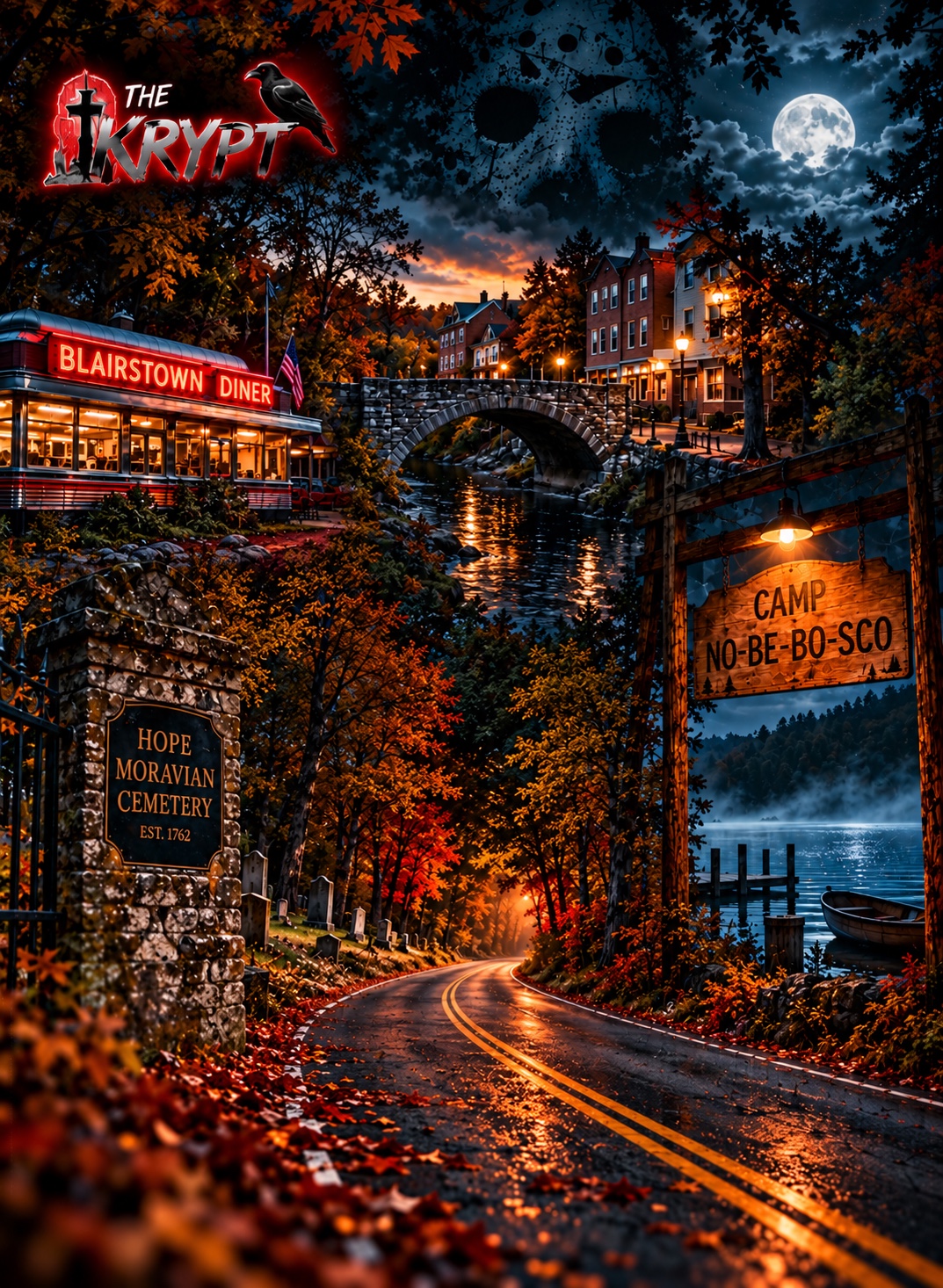
The Blairstown Diner belongs to that world of ordinary routines. Its appearance in the original film has become part of the restaurant’s identity, and the operator openly welcomes the connection that brings fans through its doors.
A diner promises company, conversation and a pause in the journey. Within a horror film, those promises acquire another meaning. Somewhere beyond the counter, the story is continuing toward a place where familiar comforts will offer little protection.
For a visiting fan, breakfast carries an appealing reversal. The screen location becomes useful again: somewhere to sit, eat and begin a day. Its significance does not require it to stop being a restaurant. The everyday activity is part of the attraction.
A town before it becomes a warning
Annie’s route through Blairstown gives the film time to establish a world beyond the camp. The Old Mill archway, Blair Place walking bridge and storefront at 26 Main Street are identified along that journey by New Jersey’s official filming itinerary.
They matter as more than recognizable backgrounds. Stonework, a pedestrian crossing and a doorway give Annie’s movement a sense of continuity. She is passing through a town, looking for the next piece of information that will carry her onward.
The film can make those modest actions ominous because the viewer is watching for danger. A building does not have to look threatening to belong in a frightening scene. Sometimes its complete indifference to the approaching story is what makes it effective.
Recognizing these places today means looking past the machinery of the franchise and returning to its smaller beginnings: a person walking down a street, asking how to reach a camp.
One doorway, two towns
The passage through the store also reveals a familiar piece of filmmaking craft. The exterior and interior do not have to occupy the same building for an audience to experience them as one place.
The Blairstown storefront supplied the exterior connection. In Hope, the former general store later associated with Hope Junction Antiques supplied the interior where Annie seeks directions. Editing joins the locations into a continuous encounter.
Learning that separation changes the pleasure of revisiting the sequence. What appears effortless on screen becomes a small construction assembled across real geography.
It also changes the visitor’s role. These buildings are not waiting sets. Their present uses, opening arrangements and property boundaries matter. The filming connection can be appreciated from a lawful exterior viewpoint; interior access requires permission.
The quiet at the cemetery entrance
At Hope Moravian Cemetery, the connection is brief but distinctive: the entrance appears behind Annie when Enos drops her off during her journey toward camp.
The scene’s significance comes from movement. A ride has ended. The destination remains ahead. Annie must continue.
That simple interruption becomes charged by the audience’s growing sense that the journey is leading somewhere she should not go. The cemetery contributes to that feeling without needing to become a spectacle.
The real location deserves a quieter response. It is a place of remembrance, with obligations to people whose reasons for being there have nothing to do with a film. Respectful viewing preserves both meanings: the recognizable image and the living community around it.
The camp beyond the screen
The road ultimately leads to Camp No-Be-Bo-Sco, the primary filming location behind Camp Crystal Lake.
Crystal Lake Tours identifies the property as the setting for more than 80 percent of the original movie. It remains private Scout-camp property, rather than an unrestricted attraction. Authorized tours provide the opportunity to visit without treating the camp’s real purpose as an obstacle.
That continuing life is part of its importance. Horror fans are approaching somewhere familiar from fiction, but the place has a history and a present beyond the nightmare.
Following the road back
The appeal of these locations lies in that overlap. A doorway can remain a doorway while becoming instantly recognizable to someone who has watched the film repeatedly. A town can carry an international horror association while continuing its ordinary routines.
For November 13, 2026, the evening Extended Tour is scheduled for 7:30–11:00 PM. Each visitor requires separate valid admission; follow the organizer’s ticket-email instructions.
The Krypt’s Trail is free to explore. The camp tour is separately ticketed, and saving the route reserves no admission.
Walk into horror history. Explore The Krypt’s Official Friday the 13th Trail, with its suggested schedule and practical guidance:
https://thekrypt.app/trails/friday-the-13th-the-road-to-camp-crystal-lake-3iurcq9u
The journey begins among streets and businesses that made the movie feel ordinary. It ends approaching a camp that the screen has made impossible to see quite ordinarily again.
Explore the real locations
Blairstown Diner: https://thekrypt.app/places/blairstown-diner-blairstown
Old Mill archway: https://thekrypt.app/places/old-mill-archway-annie-walking-sequence-blairstown
Blair Place walking bridge: https://thekrypt.app/places/blair-place-walking-bridge-annie-route-blairstown
26 Main Street: https://thekrypt.app/places/26-main-street-opening-store-exterior-blairstown
Hope general store: https://thekrypt.app/places/hope-general-store-interior-later-hope-junction-antiques-hope
Hope Moravian Cemetery: https://thekrypt.app/places/hope-moravian-cemetery-hope
Crystal Lake Tours at Camp No-Be-Bo-Sco: https://thekrypt.app/events/crystal-lake-tours-2026-11-13-1930
Sources and visiting information
Filming locations: New Jersey’s official tourism itinerary, https://visitnj.org/trail-itinerary/friday-13th ; Entertainment Weekly’s filming-location guide, https://ew.com/movies/friday-the-13th-filming-locations/
Local production history: Blair Academy, “Legends & Lore of Blair Part 7: The Filming of Friday the 13th,” https://www.blair.edu/about-blair/publications-news/post/~board/news/post/legends-lore-of-blair-part-7-the-filming-of-friday-the-13th
Diner information: https://www.blairstowndiner.com/faq
Official event details and tickets: https://crystallaketours.com/events/november-13th-2026-tours/
Use lawful parking and public viewpoints, respect cemetery hours and mourners, and obtain permission before entering private property. Camp No-Be-Bo-Sco admits visitors only during authorized events with valid admission. This feature and The Krypt’s curated Trail imply no endorsement by the film’s rights holders.